
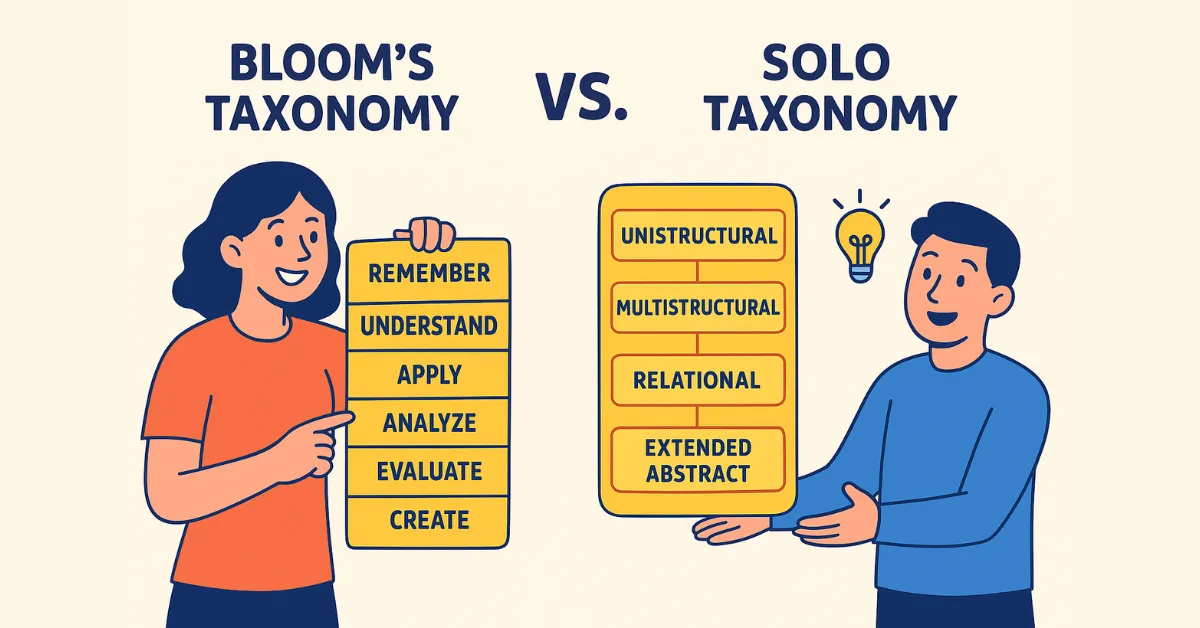
When it comes to designing meaningful assessments, educators face a fundamental question: How do we measure the depth and quality of student learning?
Two powerful frameworks have emerged as the gold standards for classifying cognitive complexity: Bloom’s Taxonomy and SOLO Taxonomy. While both help educators create more thoughtful assessments, they approach learning from different perspectives.
In this guide, we’ll explore the educational theory behind each framework, their key differences, and when to use each one for your assessments.
What is Bloom’s Taxonomy?
The Origins
Bloom’s Taxonomy was developed in 1956 by educational psychologist Benjamin S. Bloom and a committee of educators at the University of Chicago. Originally created to standardize the language around learning objectives, it has become the most widely recognized framework for classifying educational goals.
The taxonomy was revised in 2001 by Lorin Anderson (a former student of Bloom) and David Krathwohl, updating the original nouns to verbs and reorganizing the hierarchy to better reflect modern understanding of cognition.
The Six Levels
Bloom’s Taxonomy organizes cognitive skills into six hierarchical levels, from simple recall to complex creation:
| Level | Description | Example Verbs |
|---|---|---|
| Remember | Recall facts and basic concepts | Define, list, memorize, recall |
| Understand | Explain ideas or concepts | Classify, describe, explain, summarize |
| Apply | Use information in new situations | Execute, implement, solve, demonstrate |
| Analyze | Draw connections among ideas | Compare, contrast, differentiate, organize |
| Evaluate | Justify a decision or course of action | Argue, critique, judge, support |
| Create | Produce new or original work | Design, construct, develop, formulate |
Key Characteristics
- Hierarchical structure: Lower levels are prerequisites for higher levels
- Action-oriented: Uses verbs to describe observable behaviors
- Content-independent: Can be applied across all subjects
- Widely adopted: Standard framework in curriculum design worldwide
What is SOLO Taxonomy?
The Origins
SOLO Taxonomy (Structure of Observed Learning Outcomes) was developed in 1982 by professors John Biggs and Kevin Collis at the University of Tasmania. Unlike Bloom’s focus on intended learning outcomes, SOLO was designed to evaluate the actual quality of student responses.
The framework emerged from extensive research observing how students demonstrate understanding across different developmental stages, making it particularly useful for assessing what students actually produce rather than what we hope they’ll learn.
The Five Levels
SOLO Taxonomy describes five levels of increasing complexity in student understanding:
| Level | Description | Characteristics |
|---|---|---|
| Prestructural | No understanding; missed the point | Uses irrelevant information; doesn’t understand the task |
| Unistructural | One relevant aspect understood | Simple, obvious connections; limited scope |
| Multistructural | Several relevant aspects understood | Multiple facts known but not integrated |
| Relational | Aspects integrated into a coherent whole | Connections understood; sees the big picture |
| Extended Abstract | Generalizes beyond given information | Creates new ideas; transfers knowledge to new contexts |
Key Characteristics
- Outcome-focused: Assesses quality of student responses, not just intent
- Observable complexity: Measures how ideas connect and integrate
- Developmental progression: Reflects how understanding naturally evolves
- Assessment-friendly: Easy to create rubrics and marking criteria
Bloom’s vs. SOLO: Key Differences
| Aspect | Bloom’s Taxonomy | SOLO Taxonomy |
|---|---|---|
| Focus | What teachers want students to learn | What students actually demonstrate |
| Purpose | Planning learning objectives | Evaluating learning outcomes |
| Structure | Six hierarchical levels | Five levels of complexity |
| Orientation | Task-focused (what to do) | Response-focused (what was done) |
| Best for | Curriculum design & question writing | Rubric creation & response assessment |
| Origin | USA, 1956 (revised 2001) | Australia, 1982 |
A Practical Example
Consider assessing a student’s understanding of photosynthesis:
Using Bloom’s Taxonomy (designing the question):
- Remember: “List the inputs of photosynthesis.”
- Analyze: “Compare photosynthesis in C3 and C4 plants.”
- Create: “Design an experiment to test the effect of light intensity on photosynthesis rate.”
Using SOLO Taxonomy (evaluating the response):
- Unistructural: Student mentions sunlight as important
- Multistructural: Student lists sunlight, water, and CO2 but doesn’t explain how they connect
- Relational: Student explains how all inputs work together in the chloroplast to produce glucose
- Extended Abstract: Student discusses how photosynthesis relates to global carbon cycles and climate change
When to Use Each Framework
Choose Bloom’s Taxonomy When:
✅ Designing curriculum and learning objectives Bloom’s action verbs help you write clear, measurable learning outcomes.
✅ Creating questions at specific cognitive levels You can deliberately target higher-order thinking by using verbs like “evaluate” or “create.”
✅ Ensuring assessment variety Check that your quiz covers multiple cognitive levels, not just recall.
✅ Training teachers on question design Bloom’s is intuitive and well-documented with extensive resources.
✅ Aligning with institutional standards Many educational standards reference Bloom’s Taxonomy directly.
Choose SOLO Taxonomy When:
✅ Evaluating open-ended responses SOLO excels at assessing essays, projects, and complex answers.
✅ Creating marking rubrics The clear level descriptors translate directly into grading criteria.
✅ Giving students feedback on their thinking SOLO helps students understand how their thinking needs to develop.
✅ Assessing depth vs. breadth SOLO distinguishes between knowing many facts (Multistructural) and understanding connections (Relational).
✅ Promoting self-assessment Students can use SOLO levels to evaluate their own work.
Using Both Frameworks Together
The most effective approach? Use both frameworks together.
Here’s a practical workflow:
- Use Bloom’s Taxonomy to design questions at various cognitive levels
- Use SOLO Taxonomy to create rubrics for evaluating student responses
- Analyze results to identify whether students are reaching Relational/Extended Abstract levels
This combined approach ensures you’re both asking the right questions AND accurately measuring understanding.
How QuizMagic Supports Both Frameworks
QuizMagic’s AI-powered quiz generator allows you to select either Bloom’s Taxonomy or SOLO Taxonomy when creating assessments:
- Configure question distribution across cognitive levels
- Automatically tag questions with their cognitive level
- Generate balanced assessments that target higher-order thinking
- Export with cognitive metadata for analysis and reporting
Whether you’re a teacher designing classroom quizzes or an instructional designer building formal assessments, QuizMagic helps you leverage these powerful educational frameworks efficiently.
👉 Try QuizMagic Now and create cognitively-balanced assessments in seconds.
Conclusion
Both Bloom’s Taxonomy and SOLO Taxonomy are invaluable tools for educators. Bloom’s helps you design intentional learning experiences, while SOLO helps you evaluate what students actually demonstrate.
The key insight? They’re complementary, not competing frameworks. By understanding both, you can create assessments that not only ask the right questions but also accurately measure the depth and quality of student understanding.
Further Reading
- Bloom, B. S. (1956). Taxonomy of Educational Objectives, Handbook I: Cognitive Domain
- Anderson, L. W., & Krathwohl, D. R. (2001). A Taxonomy for Learning, Teaching, and Assessing
- Biggs, J. B., & Collis, K. F. (1982). Evaluating the Quality of Learning: The SOLO Taxonomy
- Hattie, J. (2012). Visible Learning for Teachers